
Several members of Parliament have opposed privatisation of public sector oil firms like IOC and have asked the government not to seek a review of the Supreme Court verdict halting privatisation of HPCL and BPCL, Petroleum Minister Ram Naik said.
A higher government borrowing will 'crowd-out' the private borrowing and push interest rates higher.

Noting that Gandhi had claimed that armed forces can restore peace in the state within days if allowed, BJP leader and former Union minister Ravi Shankar Prasad wondered if he wanted what his grandmother and then prime minister Indira Gandhi had done by ordering the Air Force to drop bombs in Aizawl in the 1960s.

'Selling could further intensify and take the index towards 22,800-22,750 in the near-term.'

Public sector oil marketing company Indian Oil Corporation (IOC) will raise prices of petrol by 27 paise a litre, - for the first time since decontrolling petrol prices.
Vijay Mallya-owned Kingfisher Airlines owes state-run oil companies over Rs 950 crore (Rs 9.50 billion0 in unpaid fuel bills while financial crisis-hit NACIL has cleared almost two-thirds of its outstanding.

Getting compensated for at least 90 per cent of losses without government subsidy appears difficult.
Over 100 chemical storage tanks built at the Pirpav jetty near Chembur have been operating without approvals from the ministry of environment and forests for over 18 years. Each of these tanks has an average capacity of 200,000 kilolitres of oil.
The Union oil ministry is considering a proposal to adopt differential pricing for diesel, under which industrial users like power utilities, will be charged market prices and retail consumers continue to be subsidised.
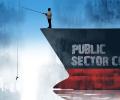
Shares of public sector enterprises have corrected by up to 22 per cent month-to-date until March 19, 2024. Analysts attribute this steep fall to the valuation exuberance seen after a sharp run in these counters last year and suggest investors remain selective regarding the stocks in this space. "The rally in public sector undertaking (PSU) stocks has been stretched and sharp, although it is somewhat justified by improvements seen in earnings, operations, balance sheets, and overall profitability.

Petrol prices were freed from government control last month, resulting in a Rs 3.50 per litre rate hike in Delhi.
OMCs losing Rs 20 crore daily on sales, 18 months after prices were deregulated.
State-run Indian Oil Corporation, Hindustan Petroleum and Bharat Petroleum currently sell petrol, a commodity which the government freed from its control in June last year, at a discount of about Rs 4.50 a litre to its imported cost.
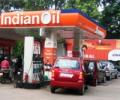
IOC and its sister PSUs, Hindustan Petroleum and Bharat Petroleum, sell diesel, domestic LPG and kerosene at rates way lower than their imported cost to help government keep general price inflation under check.
The gvernment said on Tuesday that contingency plans have been drawn to maintain continuous supply of petroleum products if the employees of privatisation bound Hindustan Petroleum Corporation Ltd go on strike.\n\n\n\n
While Indian Oil Corporation will get the highest Rs 5,817.27 crore (Rs 58.17 billion) of special bonds, Bharat Petroleum Corporation Ltd will receive Rs 2,144.32-crore (Rs 21.44 billion) bonds and Hindustan Petroleum Corporation Ltd will be issued bonds worth Rs 2,038.41 crore (Rs 20.38 billion). The bonds will carry an 8 per cent coupon rate and will mature in 2026, the government said in a statement.

Kaushik Basu, chief economic advisor in the finance ministry, said, "All I can say is, we are very serious about fiscal consolidation, and intend holding on to our fiscal targets, even if the crude price rises on a sustained basis."
The government on Wednesday said there was no proposal to either merge Hindustan Petroleum and Bharat Petroleum with Oil and Natural Gas Corp or Oil India Ltd with Indian Oil Corporation.
The petroleum ministry has sought additional oil bonds worth about Rs 13,000 crore (Rs 130 billion) to cover the revenue loss on fuel sale in the fourth quarter of the current fiscal.
Higher crude oil prices have almost doubled the under-recoveries of government-owned oil marketing companies -- Indian Oil Corporation, Bharat Petroleum and Hindustan Petroleum -- in the past three years.
The bonds will help oil marketing companies - IOC, HPCl, Bharat Petroleum and IBP Ltd - to cover their under-recoveries.

With the new Bharat Stage IV emission norms coming into effect from Thursday, oil companies are gearing up to meet the requirements of Mumbai, an official said on Friday.
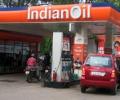
State-owned fuel retailers, which last week raised petrol price by Rs 1.80 per litre, reported a net loss of over Rs 8,000 crore (Rs 80 billion) in July-September quarter and are borrowing heavily to even buy crude oil.
A series of rises in petrol price following its decontrol on June 25 last year has increased the state governments' earnings from value added tax on petrol by around 21 per cent.

It is in talks with a local player for a discovered asset so that it can have a ready cash flow in one or two years.
The combined debt of Indian Oil, Bharat Petroleum and Hindustan Petroleum has risen to Rs 115,000 crore (Rs 1,150 billion) as they borrowed to make up for revenue losses on fuel sales during the first half of the current fiscal.

IOC and other state retailers had on September 16 raised jet fuel price by 2.5 per cent.
Despite raising petrol prices by around Rs 2.95 a litre - the second-biggest increase in this calendar year so far - public and private retailers are losing Rs 50 crore a day on selling the auto fuel.
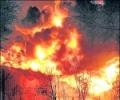
The 7-member committee, headed by former Hindustan Petroleum chairman M B Lal attributed the fire to lack of safety procedures and human error.
A Parliamentary Committee asked the government on Thursday to seek approval of Parliament before privatising oil refiners Hindustan Petroleum Corporation Ltd and Bharat Petroleum Corporation Ltd as the two were nationalised

The basket of crude oil India buys from overseas markets averaged $68.07 per barrel in September as against the August average of $71.98 a barrel.
